
Cosmetic shelf life: what PAO means and how to store skincare after opening
Sunday 11th October 2026
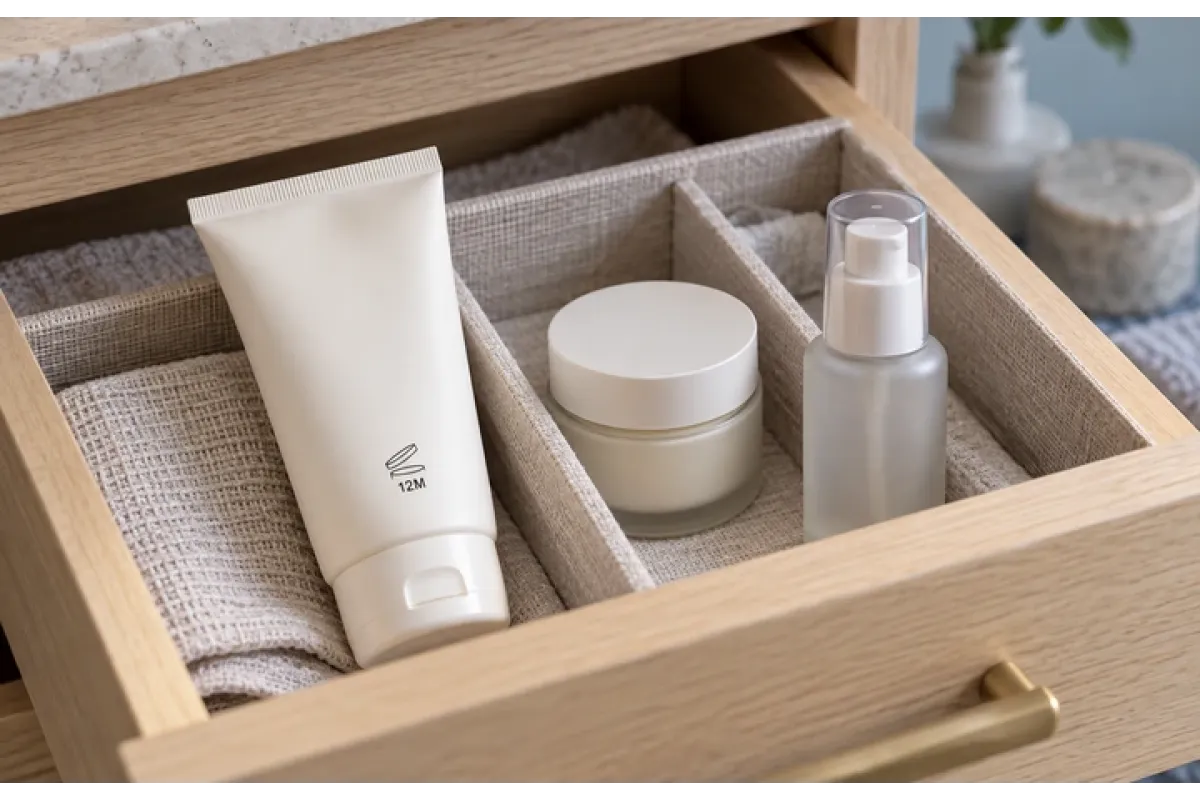
A new cream is tempting to open straight away and place beside your favourite serum. Before doing so, take a moment to read its label. A durability date, the open-jar symbol and a batch code answer different questions. Understanding them helps you choose a suitable size, use products in time and organise your routine without a shelf full of simultaneously opened bottles. Start with the packaging of your own product: it tells you how long to keep it and which storage conditions to follow.
Three label details to tell apart
Check the bottle base, the tube seam, the back label and the box. Information need not all appear on the front. Official GOV.UK guidance distinguishes minimum durability, PAO and batch identification. The following is a practical way to read these details; labelling requirements can differ between markets.
A calendar durability date
A date beside the relevant wording or an hourglass symbol provides a calendar reference. Read it fully: the pack may show month and year, or day, month and year. Check storage conditions too. Buying a new bottle does not restart this date, and leaving it unopened does not cancel it. If the manufacturer separately labels a production date, distinguish that from the durability date.
PAO: the period after first opening
PAO means Period After Opening. It commonly appears as an open jar marked 6M or 12M: six or twelve months after first opening for use. It is not the number of months after ordering or delivery. Use the figure on your own product rather than a familiar period from another cream. PAO may not apply to certain formats, such as single-use portions; follow their own directions.
A batch code
A batch code or LOT helps the manufacturer identify a production batch. It may combine letters and numbers, but is not itself a consumer-readable durability date. If you need it decoded, keep a photo of the code and the exact product name, then ask the seller or brand. An online calculator without manufacturer confirmation does not replace the information on your particular pack.
How to count time after opening
Record the date when you first open the product for use. For a hypothetical pack marked 6M opened on 1 March, the six-month period ends on 1 September. This illustrates the calculation, rather than suggesting that every cream lasts six months. If the pack also has a calendar date, respect both limits: the period after opening does not extend that date.
- Write down opening day. A small sticker or phone note is more reliable than remembering which season you bought the bottle.
- Keep the original starting point. A break in use and closing the lid again do not reset time after opening.
- Check the directions. Specific storage and usage instructions matter alongside dates, especially for single-use formats.
Do not cover the batch code or warnings with your sticker. If keeping the box is inconvenient, photograph its information before recycling it. For a seasonal product, add a reminder to check before the next use. You will then have a record rather than trying to guess the bottle's age months later.
Where to keep cosmetics at home
The FDA highlights heat, light, moisture and handling as factors affecting shelf life. Choose a place that follows the directions and is convenient for daily use. A closed cupboard away from direct sunlight and heat sources is generally more practical than a windowsill or a shelf beside a radiator. Avoid leaving your beauty bag in a hot car.
Assess the actual location in your bathroom: does water splash onto the pack, is it beside a heated towel rail, and can you keep it dry? A bottle on the shower edge and one in a dry, closed cupboard face different conditions. After using a product, close it and put it away rather than leaving it open beside the basin.
Use the fridge only when the manufacturer specifies that storage method. Cooling does not justify extending PAO or a durability date. For products without special instructions, do not invent a universal storage temperature; the appropriate conditions depend on the product. When travelling, retain the label and protect the pack from overheating, following its directions.
What the packaging format changes
Jars, tubes and pump bottles call for different handling. Choose a format you can use cleanly and carefully. A pump helps dispense the product, but does not give it an indefinite life. Convenient packaging makes following directions easier; you still need to check its use period.
| Format | A useful habit | What to check |
|---|---|---|
| Jar | Clean hands or a clean suitable spatula; close the lid promptly | PAO, lid condition and keeping water out |
| Tube or pump | Keep the nozzle and cap clean | Markings on the seam or base and intact packaging |
| Dropper bottle | Use as directed, avoiding unnecessary skin contact | Opening date and storage conditions |
| Single-use portion | Open before its intended use | Whether leftovers may be kept: only according to directions |
Where possible, leave skincare in its original packaging. If the instructions allow transfer to a travel container, label the product and the date you first opened the original bottle. A new container does not restart the period. Avoid topping up old leftovers with fresh product: it then becomes harder to track the contents and their age.
A shop example: compare brand information with the pack
NovExpert's FAQ states six months after opening. This is useful when planning a routine. Before use, check your own pack and ask the brand about any discrepancy. Do not apply one manufacturer's period to the shop's entire range.
Wellness Expert stocks NovExpert Paris Magnesium Velvety Hydrobiotic Cream 30 ml, an example of a cream in a small size. Consider the volume alongside frequency of use and products you already have open. Check the PAO of the cream you receive on its packaging. Price, skin type and a “natural” label do not establish one common period for every product either.
When to stop using a product
If its smell, colour or texture changes unexpectedly, stop and ask the manufacturer about its condition. Compare it with how it was when first used. Separation may be intended in a two-phase formula, so first read any shaking directions. Avoid trying to restore a questionable product by adding water, oil or another cream.
Appearance is an additional check, rather than a way to extend the stated period. A normal smell does not confirm that a product past its date or PAO remains suitable. If you cannot remember opening it, look for a note or photo. If you cannot establish its history, discuss the situation with the brand. Do not test questionable cosmetics by applying them to skin.
Damaged packaging or water getting inside are also reasons to stop and seek advice about that particular product. If use causes discomfort, discontinue it; retain the name and batch code for your enquiry. Leftover expired face cream need not be used on the body simply to finish the jar.
Choose a size without opening more than you need
When comparing cost per millilitre, consider your own rate of use. A larger size may suit a familiar daily product. If you alternate several creams or use a product occasionally, a smaller size may fit your routine better. Do not increase the recommended dose to finish it quickly, or open a spare bottle before you need it.
Before buying, see what already does the required job in your morning and evening routine. Our guide to skincare order can help identify where a new product belongs. One clearly chosen cream for each suitable stage is often easier to keep track of than several similar open jars. When buying a set, plan when to start each item rather than opening everything at once out of curiosity.
Plan seasonal and occasional products separately. A mask used according to its directions and a daily cream have different consumption patterns. If you are choosing a skincare texture, see our article on gels, emulsions, creams and balms. A suitable size complements the choice of formula and application routine.
A simple system for your skincare shelf
- Read the label before opening. Find the date, PAO, batch code and storage directions.
- Record first use. Note the date on a separate sticker or in your phone.
- Add a reminder. Calculate the reference point from your PAO, respecting an earlier calendar date if one is shown.
- Check before ordering. Review what is still open and what actually needs replacing.
A brief record for each product needs only four details:
- Name and size — to distinguish similar packs.
- First opening date — to count PAO.
- Period and conditions on the label — without guessing from a neighbouring product.
- A photo of the label and batch code — for questions to the seller or brand.
This takes a few minutes when opening a new product. It helps you plan purchases, keep an orderly shelf and use cosmetics within their stated conditions and time limits.
Mila Serani, Skincare & Beauty Editor at Wellness Expert